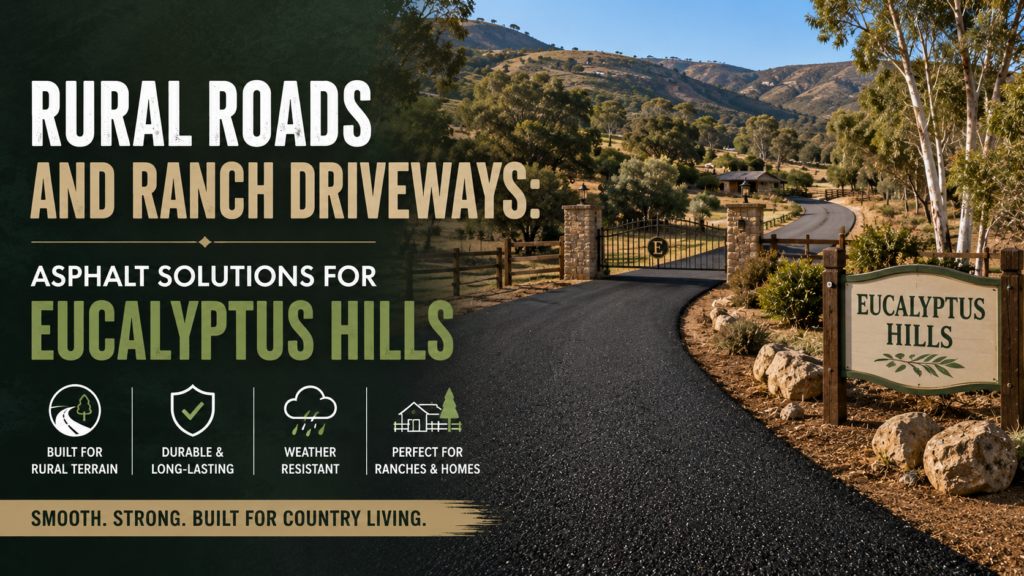
Nestled in the rolling foothills of East County, Eucalyptus Hills offers a unique blend of rural character and suburban convenience. Unlike the dense urban grid of downtown San Diego, Eucalyptus Hills features long, sloping driveways, private lanes, and horse properties. For property owners here, paving is not just about aesthetics it is about dust control, erosion prevention, and accessibility. Working with an Asphalt Contractor Eucalyptus Hills trusts means understanding the specific demands of rural paving.
The Challenge of Sloped Driveways
Many homes in Eucalyptus Hills are situated on hillsides to take advantage of the panoramic views. While beautiful, these sloped driveways present engineering challenges. Asphalt is a flexible pavement; on a steep slope, gravity constantly pulls downward on the material.
During installation, the contractor must use a stiffer asphalt mix with a higher binder content to resist “creep” (the slow movement of the surface downhill). Additionally, proper rolling technique is critical. Rollers must work uphill to push the material into place rather than downhill which would stretch the mat. A poorly installed sloped driveway will develop washboarding ripples across the surface within months.
Dust Control and Rural Living
Eucalyptus Hills has many unpaved roads and gravel driveways. While gravel is cheaper upfront, it comes with hidden costs: constant dust, mud after rains, and the need for frequent regrading. Dust from gravel driveways coats cars, infiltrates homes, and can aggravate respiratory issues for both humans and animals.
Asphalt eliminates dust entirely. The surface is solid and sealed, meaning no fine particles become airborne. For horse owners, this is a significant health benefit respiratory issues in horses are often linked to dust from arenas and driveways. A paved driveway also prevents mud holes from forming around water troughs and barn entrances.
Heavy Load Considerations
Rural properties often see heavier vehicles than standard suburban neighborhoods. Delivery trucks, propane delivery vehicles, horse trailers, and RVs are common. A standard residential driveway (2-3 inches of asphalt over 4 inches of base) may not suffice for a property that sees loaded hay trucks or livestock trailers.
For Eucalyptus Hills, a heavy-duty section is often recommended near the garage or barn. This might include 4 inches of asphalt over 6 inches of crushed base. The thicker profile distributes the weight of heavy axles over a larger area, preventing the pavement from cracking under concentrated loads.
Edge Support and Shoulders
On rural properties, the edge of the driveway is vulnerable. Unlike city streets with concrete curbs, rural asphalt edges are exposed to the elements. Grass, weeds, and roots can grow under the edge, undermining the pavement. Rainwater can wash out the soil supporting the edge, leading to “edge raveling” where the asphalt crumbles.
Solutions include installing a compacted gravel shoulder alongside the pavement or using treated timber edging to hold the asphalt in place. Some property owners opt for a “bleeder” edge where the asphalt is tapered thinly into the native soil, allowing vehicles to pull off without damaging the pavement.
Asphalt for Equestrian Facilities
Eucalyptus Hills is home to many horse owners. Asphalt is increasingly popular for horse barn aisles, wash racks, and round pen tracks. However, horse-friendly asphalt requires special considerations.
The surface must be non-slip, even when wet. This is achieved by using a specific aggregate gradation that leaves a slightly textured surface. Additionally, the asphalt must be resistant to urine and manure, which can be acidic and degrade standard binders over time. Some specialized equestrian asphalt mixes include additives that resist acid breakdown. The base must also be extremely well-drained to prevent ammonia buildup from standing urine.
Turnaround Areas and Maneuvering Space
Rural driveways are often long and narrow. Backing a horse trailer or a long RV down a winding driveway is difficult and dangerous. Many Eucalyptus Hills properties benefit from strategically placed turnaround areas or hammerhead turnarounds.
A well-designed turnaround is typically 50-60 feet in diameter to allow a full-size truck and trailer to turn around in one maneuver. The paving in these areas experiences high shear stress as wheels turn while stationary. Therefore, these zones require a thicker, more durable asphalt mix or sometimes concrete reinforcement in the center pad.
The Longevity of Rural Asphalt
With proper maintenance, an asphalt driveway in a rural setting can last 25-30 years. The key factors are base preparation and drainage. Because rural properties have more space, contractors can design drainage swales (shallow ditches) that run parallel to the driveway, intercepting water before it reaches the pavement.
Unlike urban environments where gutters and storm drains handle water, rural asphalt relies entirely on surface crowning (the center of the driveway being slightly higher than the edges) and side ditches. A crown of ¼ inch per foot of width is standard. For a 12-foot wide driveway, this means the center is 1.5 inches higher than the edges, ensuring water sheets off to both sides.
Recycled Asphalt for Rural Economics
Many rural property owners ask about recycled asphalt because it offers a middle ground between gravel and virgin hot mix. Recycled asphalt (often called “millings” or “RAP”) is crushed, recycled pavement. When spread and compacted, it can harden into a durable, low-dust surface.
However, recycled asphalt is not as strong as hot mix. It works well for low-speed, low-traffic areas like long access lanes, but it may rut under heavy trucks or turning vehicles. For high-use areas like the garage apron or turnaround, virgin hot mix is superior. Some property owners choose a hybrid approach: recycled asphalt for the long lane, hot mix for the parking pad.
Environmental Considerations
Eucalyptus Hills is named for its abundant eucalyptus trees. These trees are beautiful but problematic for pavement. Eucalyptus trees drop leaves, bark, and sap that can stain and degrade asphalt. More importantly, eucalyptus roots are aggressive and will seek moisture under pavement.
When paving near eucalyptus trees, root barriers are essential. These are vertical sheets of plastic or metal installed 18-24 inches deep along the pavement edge. They redirect roots downward, preventing them from growing under the asphalt and causing heaving. Alternatively, contractors can specify a geotextile fabric beneath the base layer that roots cannot penetrate.
Permitting and Rural Regulations
San Diego County has specific requirements for driveway construction in unincorporated areas like Eucalyptus Hills. Driveways must meet fire access standards: typically, a minimum width of 12 feet (20 feet for two-way traffic), a minimum vertical clearance of 13 feet 6 inches, and the ability to support fire apparatus weighing up to 75,000 pounds.
Additionally, driveways longer than 150 feet may require a turnaround area approved by the fire marshal. A knowledgeable local contractor will be familiar with these codes and can ensure that the new asphalt driveway complies with all safety regulations, avoiding costly rework or fines.
Ultimately, paving a rural property in Eucalyptus Hills is an investment in convenience, safety, and property value. From dust-free parking to all-weather access, asphalt transforms the rural living experience.