Queue Management System in Saudi Arabia: A 2026 Guide for Faster Service
Long lines cost more than patience. In busy banks, clinics, and government service centers across the Kingdom, every extra minute of waiting chips away at customer trust and staff morale. A modern queue management system in saudi arabia turns that chaos into an orderly, measurable flow that both visitors and managers can actually see and control.
This guide explains how these systems work in 2026, which features matter most for Saudi organizations, and how to roll one out without disrupting daily operations. Whether you run a single branch in Riyadh or a national network of outlets, the goal is the same: shorter waits, happier people, and sharper data.
Why a Queue Management System in Saudi Arabia Matters Now
The Kingdom’s service sector is expanding fast under Vision 2030, which prioritizes citizen experience and digital transformation across public and private services. You can read the official objectives on the Saudi Vision 2030 portal, where customer satisfaction and efficient government services are repeated themes.
That ambition filters down to the branch level. Residents in Jeddah, Dammam, and Riyadh now expect the same frictionless experience they get from a mobile app. A physical queue that stalls for 40 minutes feels broken by comparison.
Queue systems answer that expectation. They replace the scramble around a counter with a calm, ticketed process, and they give branch managers the numbers to prove whether service is improving month over month.
The Hidden Cost of Unmanaged Lines
- Walkaways: Customers who see a long line often leave and never return.
- Staff stress: Agents face frustrated visitors with no way to prioritize fairly.
- No data: Without logs, managers cannot spot peak hours or staffing gaps.
- Compliance risk: Crowded lobbies make safety and accessibility harder to maintain.
Core Components of a Modern Queue System
A complete solution is more than a ticket printer. It is a connected set of hardware and software that guides a visitor from arrival to resolution, then feeds every step back into a reporting dashboard.
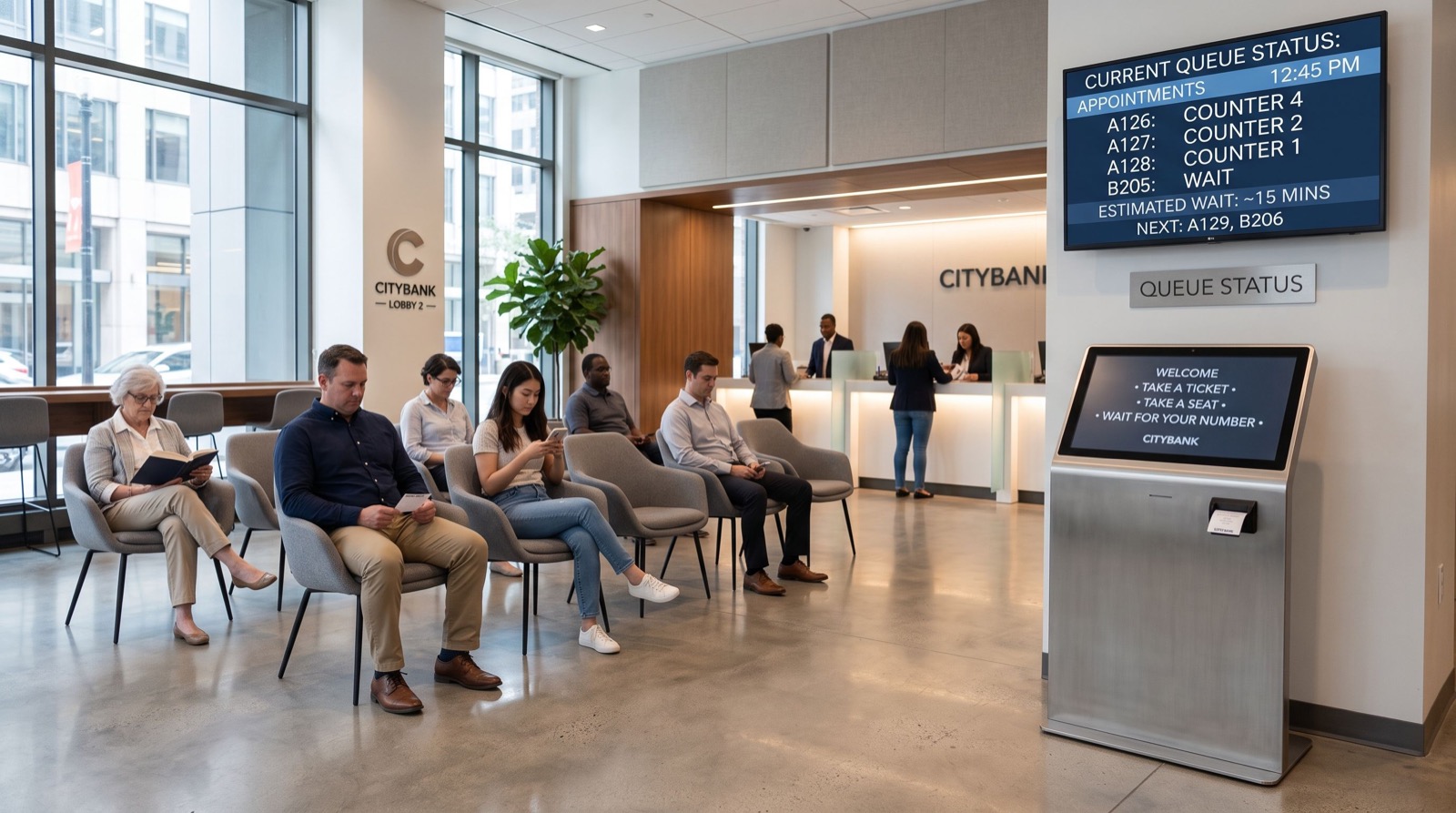
- Ticketing kiosk or mobile check-in: Visitors select a service and receive a token, either from a touchscreen or a QR code on their phone.
- Digital signage: Large displays call the next number in Arabic and English, with audio announcements.
- Counter terminal: Agents call, transfer, or recall tickets with one tap.
- Central dashboard: Supervisors watch live wait times, service times, and counter status.
- Analytics engine: Historical reports expose trends by hour, day, branch, and service type.
The best deployments integrate with existing CRM and appointment tools, so a booked visit and a walk-in share the same intelligent queue. For organizations that also serve customers in vehicles, pairing the lobby system with a Drive-Thru Solution in Saudi Arabia keeps the experience consistent whether people walk in or drive up.
Key Features to Compare Before You Buy
Not every platform fits every organization. Use the table below as a quick checklist when you shortlist vendors for a queue management system in saudi arabia.
| Feature | Basic System | Enterprise System |
|---|---|---|
| Arabic / English interface | Yes | Yes, plus RTL signage |
| Mobile virtual queue | Limited | Full app and SMS |
| Multi-branch dashboard | No | Yes, centralized |
| Appointment integration | Optional | Built-in |
| Real-time analytics | Daily export | Live KPIs and alerts |
| Customer feedback capture | No | On-screen rating |
Prioritize bilingual support and multi-branch reporting. These two features deliver the clearest returns for Saudi networks that need to compare performance across cities.
How Different Saudi Sectors Use Queue Systems
Banking and Finance
Banks route premium clients to dedicated counters while keeping routine transactions moving. Wait-time data helps branch managers justify staffing during salary-payment peaks at month end.
Healthcare
Clinics separate registration, consultation, and pharmacy queues so patients are not stuck in one giant line. Calling patients by token also protects privacy.
Government Service Centers
Public offices handle high volumes of varied requests. Service-specific tickets ensure a passport renewal does not block a quick document stamp, improving satisfaction scores that leadership now tracks closely.
Retail and Telecom Stores
Mobile operators use virtual queues so customers browse devices while they wait, then get an SMS when their turn is near. This single change can noticeably cut perceived waiting time.
Implementation Roadmap for 2026
A smooth rollout follows a clear sequence. Rushing hardware into a branch without planning the service flow is the most common mistake.
- Step 1 — Map services: List every service type and its average handling time.
- Step 2 — Pilot one branch: Install, train staff, and gather two weeks of baseline data.
- Step 3 — Tune routing rules: Adjust priorities based on real wait patterns.
- Step 4 — Scale the network: Deploy to remaining branches with the central dashboard live.
- Step 5 — Review monthly: Use analytics to rebalance staff and set service-level targets.
Choosing an integration partner matters as much as the software itself. Working with dependable specialists who understand both the hardware and the local service culture shortens the learning curve dramatically.
One practical tip from real deployments: always test the audio announcement volume in a full, noisy lobby before launch, not in an empty room. Teams routinely set it too low and then field complaints about missed calls in the first week.
Equally important is signage placement. Mount displays where a waiting visitor can read them from a seat without craning their neck, and keep the font large enough to read from the far wall. Small layout choices like these decide whether the system feels effortless or frustrating in daily use.
Frequently Asked Questions
How much does a queue management system in Saudi Arabia cost?
Costs vary with branch count, hardware, and software tier. A single-branch setup is modest, while an enterprise multi-site network with mobile queuing and analytics is a larger investment. Request a quote based on your exact service map rather than a flat list price.
Can it support both Arabic and English?
Yes. Reputable systems offer full bilingual kiosks, signage, and announcements with right-to-left Arabic layouts, which is essential for mixed-audience branches in the Kingdom.
Does it work with online appointments?
Modern platforms merge booked appointments and walk-ins into one smart queue, so a customer who booked online is slotted fairly alongside those who arrive in person.
How long does installation take?
A single pilot branch can go live within days once the network and service flow are mapped. A larger rollout is usually phased over several weeks to protect daily operations.
Conclusion
A well-chosen queue management system in saudi arabia does more than shorten lines. It turns every visit into measurable data, lifts customer satisfaction in line with Vision 2030 goals, and frees staff to focus on service instead of crowd control. Map your services, pilot one branch, and scale with confidence. Ready to reduce wait times in 2026? Reach out for a tailored demo and start building a faster, calmer branch experience today.